• Our broken money system can be fixed

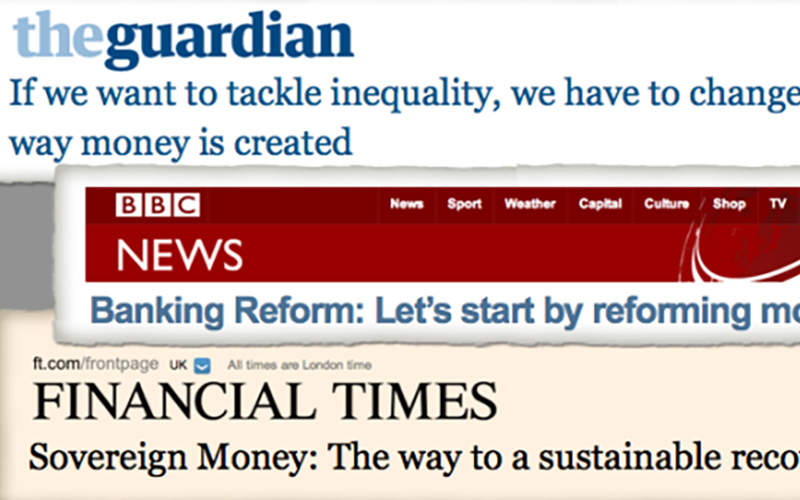
    By changing the way that money is created, we can tackle some of the major social and economic problem we're facing today.

    Watch the Talk (30 mins)

Our Proposals

If we want to deal with the big social, economic and environmental challenges that we’re facing today, then reforming the monetary system is a good place to start. We’ve spent the last three years researching the problems caused by the current debt-based monetary system and developed in-depth proposals.

What We Need

This is what we think needs to change to fix our broken money system:

1. Money should only be created through a democratic and transparent body working in the public interest.

We’d like to see the power to create money transferred to a democratic, accountable and transparent process, where everyone knows who has the power to create money, how much money they create, and how that money will be used. However this process is set up – whether it’s the Bank of England or a new committee that decides whether to create money, it must be accountable to Parliament and protected from abuse by vested interests. We also want to see safeguards that ensure that the right amount of money is created – not too much (causing bubbles and a financial crisis) and not too little (causing a recession).

2. Money should be created free of debt

Currently, banks create money when they make loans, which means that for every pound in your bank account, someone somewhere else will be a pound in debt. It means that almost all the money in the economy is effectively ‘on loan’ from the banking sector, and interest must be paid nearly every pound that exists. If we try to reduce our debts, money disappears from the economy, making it harder for others to repay their own debts. But if money was created by the state, in the public interest, and spent into the economy through government spending instead of being lent into the economy by banks, then that money would stimulate the real economy, create jobs, and make it possible for ordinary people to start reducing their own debts.

3. Money should come into the real (non-financial) economy before it reaches financial markets and property bubbles

Any newly-created money should be used to fund public spending, reduce taxes, pay down the national debt or even just distributed to citizens. This means that the money will start its life in the real (non-financial) economy instead of getting trapped in financial and property markets, as happens at the moment.

This will help the economy grow, creating jobs in the process, whereas much of the money that banks create today simply makes life more expensive and unstable for people.

4. Banks should not be allowed to create money

History has shown that when banks have the power to create money, they create too much in the good times, causing financial crises, and then create too little money in the bad times, making recessions and unemployment even worse. They put most of the money that they create into house price bubbles and speculation on financial markets, and only put a small amount into businesses outside the financial sector. We simply don’t think that banks, with all their incentives and need to maximise their profits, can be trusted with something as powerful as the ability to create money. And it’s not enough to regulate them, because regulators have already failed to keep them under control, and there’s no reason why they should get it right this time around. We need to stop banks being able to create money.

Further Information

  • Video

    Video (33 mins)

    Positive Money Founder, Ben Dyson, presenting at the 3rd annual Positive Money Conference “Modernising Money” on 26th January 2013 in London, explains the main principles behind the monetary reform proposals which offer one of the few hopes of escaping from our current dysfunctional monetary system. Watch now (33 mins)

  • Screen Shot 2013-03-22 at 6.50.38

    In Plain English

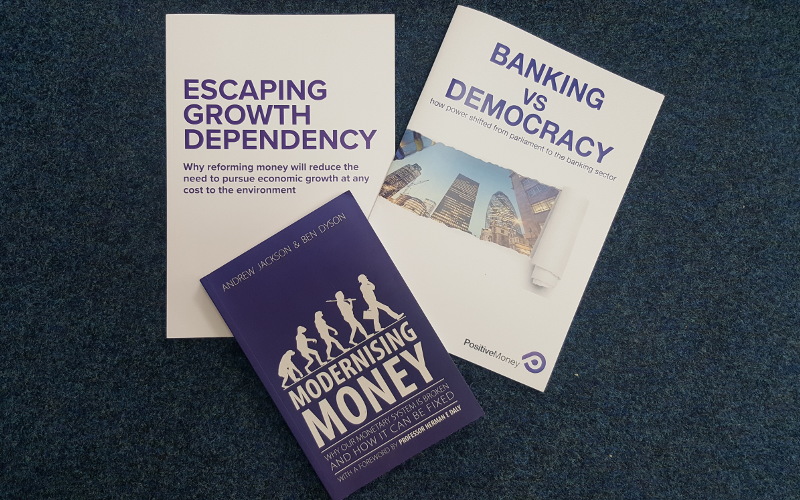
    A 30-page plain English explanation of how we can fix our money system, written for people with no background in economists or banking. It explains how we can prevent commercial banks from being able to create money, and move this power to create money into the hands of a transparent and accountable body, who would create money in line with the needs of the economy and grant it to government to be spent into the economy.

    More info and free download

  • Screen Shot 2013-01-31 at 15.11.08

    Modernising Money

    Why Our Monetary System is Broken, and How We Fix It. The product of three years of research and development, these proposals offer one of the few hopes of escaping from our current dysfunctional monetary system. It is detailed but accessible to non-economists.

    Buy Now & More Info

  • Screen Shot 2013-04-02 at 15.59.33

    The Positive Money System (Technical)

    A more technical presentation of our reforms, for economists and those with some knowledge of money and banking. It explains how the reforms work from the perspective of a) bank customers, b) the banks themselves and c) the central bank.

    More info and free download

  • draftlegistation

    Draft Legislation

    This unofficial draft bill shows how our proposals could be implemented in law in the UK parliament.

    More info and free download


Help us change the money system!

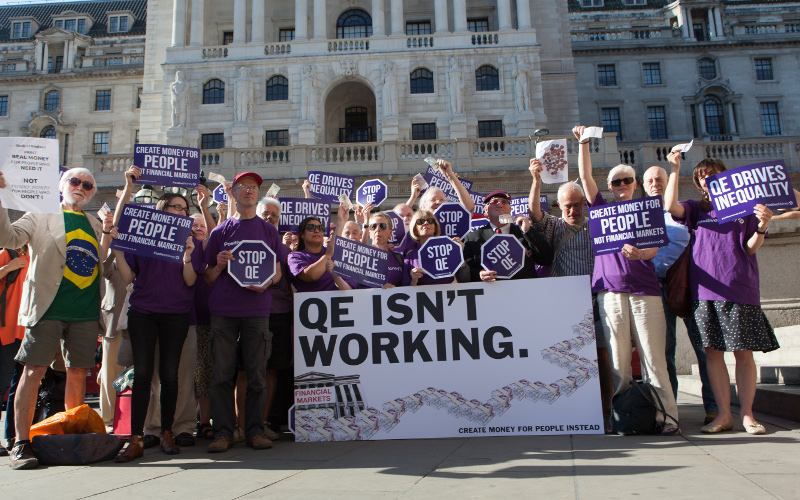
We're campaigning to democratise the creation of money and prevent another financial crisis.
  • Add your name to the 11,564 people who want to change the debt-based money system:

    Please check your email is valid.

    Please wait a few seconds while we take you to the next step...
    We send news updates and videos fortnightly. You can unsubscribe at any time and we never share your details.


  • jagung808 .

    Real money are gold and silver. If these two precious metals are in scarcity, use commodities like barley,wheat,salt etc. Real money has intrinsic value in it.

    • Chris Kerr

      I recently heard about a (half-joking) proposal to have a currency backed by bricks instead of gold. At least from a naive viewpoint, this actually makes quite a bit of sense. The biggest problem with commodity standards is that they require scarce resources to be piled up in useless heaps rather than put to economic use; bricks piled on top of one another (in the shape of a wall etc) are still economically useful so this waste does not occur. Additionally, the fact that bricks are bulky and hard to transport would make speculative attacks much less likely.

    • http://blog.mjburgess.co.uk/ Michael Burgess

      How do any of those things have “intrinsic value”?

  • http://www.facebook.com/robbeasley Rob Beasley

    The issue is not money. The issue is and always will be about the allocation of scarce resources. Therefore you need a transaction system that transparently discloses the relationship between money and that which it was designed to represent, resources. In particular, elimination of all derivatives would be helpful. Prof. J.H.De Soto has a good first step strategy to move away from the current state with relatively simple steps.

    In the end though, a resource based economy is the best option. Those models however need to be built from the ground up. New Cities are probably worth considering.

  • Barry Cooper

    The problems described are quite real, but the proposal simply transfers power from banks to the government. Whoever has the power to create money has the power to create wealth from nothing. Why is this intrinsically better when done by the government? Why not anticipate an expansion of the symbiotic relationship that already exists between Big Business and Big Government? Because your panel somehow becomes ethically superior? There is no functional difference between banks creating money for themselves, and money being created by government and parceled out to chosen corporations.

    The logical solution is to end money creation outright. This is the ONLY equitable solution, the only solution that does not recreate a de facto master/slave relationship.

    My proposal to do this is here: http://www.goodnessmovement.com/Page23.html

  • Andrew Webb

    Love the new website.

    We have all been brain washed to believe that only the banks are smart enough to create money responsibly. Any alternative that a nation creates its own money supply is treated with complete horror. In true reality, the banks create inflation and deflation on a regular scale. The world economies are constantly unstable because of it. The world is in a deep financial crisis now because of this very fact.

    The real question we should really be asking ourselves is, why are we allowing an independent identity create our money supply when we
    could do it ourselves. The system we have now is unsustainable and can only get worse.

    Money, or the financial credit of an economy, should be an exact and scientific reflection of the actual goods and services, or real wealth, of an economy. If this is followed any independent nation of the world
    can be free from the grips of debt.

    I am glad that you are now looking on using Dividends as a
    way to increase the money supply to the population as well. This was an
    important factor missing until now. Those who do not know the importance of using the Dividend would benefit from reading this section below.

    The reality is that there will never be full employment and why go there any way when we don’t need to? As time moves forward the need of people to work becomes less and less. This should be good! New technologies in all industries are reducing the number of people needed to work there. Machines are taken the jobs from people and the number of hours people work will be reduced.

    Unfortunately, the way it works some industries are affected more than
    others leaving skilled workers redundant no longer required. These people are thrown on the stock pile of the unemployed (also made much worse by the global financial crisis)

    New machinery and technologies should be for the benefit of mankind. These advances should not be negative but positive allowing the population in general to work less and less. The problem here is that as fewer hours are worked,fewer hours are paid for. Do you see the problem? People are getting poorer as wages or jobs are lost. When the population’s wages are reduced their spending is also reduced.

    As a consequence goods remain unsold in stores and shops. You know the rest, higher unemployment and higher levels of government assistance as people’s wages fall below certain levels. Lost tax
    revenue and higher government costs to manage this spiraling problem means further government debt or higher taxes.

    The real wealth in this world is in the land and what we
    make of it such as farming, building and Industry. To distribute this wealth we need a medium of exchange. The role of money is to provide and easy medium to buy and sell things. This money must be produced in correct quantities without cost.

    The production of modern times is vastly different from
    early times. We have now leaped ahead with giant steps in mass production. We have massively increased our capacity to build, grow and manufacture things with an increasingly lower work force required. This progress is passed on from one generation to another and It is a heritage we should all benefit from. Unfortunately this is not the case.

    Because production is no longer the result of labour only, it is a farce to believe that production can be distributed only through the reward of labour. It is the fruit of progress and not labour which is providing these great achievements. There for we must look at this in a different light. As new production methods expand, less labour is required resulting in a rising number of permanently unemployed people. It would also be true that working hours of the work force as a whole is reducing. If people only got paid by the hours they worked their wages would fall.

    To recognize this progress as a national heritage for everyone, a dividend could be used to supplement these lost wages. This heritage should be shared and not lost in the hands of a few. A Dividend could
    also be issued to the whole population when the money supply needs increasing.

    Presently when a nation needs to increase its money supply, it will usually get this from the commercial banks as debt. The Central Bank will inject new money first (usually as debt to the nation) which commercial banks will then multiply through fractional reserve banking. The nature of lending this way means the country will always have a growing need for money to pay its debts, including compound interest.

    With true Credit Creation running, the ability to create new money as credit to the nation is now possible. Money from now on is created on the basis of its real wealth. (This is a primary goal all nations should practice) The money supply should always be kept in check and inline with production of goods and services. A National Credit Office would be set up to ensure a correct money supply in the economy, by issuing or
    withdrawing of money in accordance with the country’s production capacity and demand.

    A national dividend to the population could also be used to expand the
    money supply, very much like stimulus packages used lately to stimulate
    economies. The richer the country is in real wealth the less taxes if would
    require and the more buying power each person has in its currency.

    Hope this makes sense.

    Andrew Webb
    (From Bleeding In Debt)

  • vhammon

    Your proposal suggest using an inflation rate of 2% as a criteria for new money creation. I’ve read both your books (excellent! and VERY well written) and did not find a rationale for planning for steady inflation. How about using population and productivity to maintain a stable money supply, without inflation? If the inflation issue is about encouraging innovation—I can’t think of any other reason that would weigh more than the disadvantages of continuing a system of exponential growth—, couldn’t that be addressed directly with a 1% for innovation ?

  • joe

    You say you are looking specifically, for people with
    experience of the present – corrupt – financial system to help you “govern” this site. This means you are simply a part of the same problem that exists already since you think you can address this financial problem using THE SAME experience and mindset that created it in the first place – thus, you are more a distraction than solution. You are clearly, more interested in your own rule-making “power” than the actual problems at hand

    You talk about “Human Resources” yet do not appreciate that your acceptance of, and casual use of this very phrase exemplifies the rottenness and base cruelty of the current system – and reflects the fact that you too, happily accept their notion that precious human beings may be regarded as nothing more than a “resource” commodity. Again, your happy use of this vile and disgusting term without conscious appreciation of what it actually infers, demonstrates that you are little more than a distraction – and a grotesque one at that

    “Become a director of Positive Money

    Positive Money is looking for new board members to join our board of directors who can make a significant and positive contribution to the governance of the organisation. In particular we’re looking for directors with at least 10 years experience in areas such as finance, management,
    corporate governance and risk management, company
    law, fundraising and HR.

  • Phil

    It’s all nice and good to have a website with tons of information but what do you guys do to reach the mainstream? It would be good to publish a campaign plan with well defined objectives & milestones and track progress against the plan. You can then reach out to the +10K followers to help meet these objectives. What about a fund raiser to buy a full page in the FT? What about organizing a peaceful walk through the city? Without a proper and transparent program I am afraid your campaign will fizzle out.

Support Us

Support Positive Money through your small business, or as an individual.
Proudly supported by rebuildingsociety.com, a peer to peer lending network that connects local business borrowers with many lenders looking for a better return on saving than what the banks offer.

Site designed by G-Graphic.

Get in touch

Follow Us

Recent Posts