Back to Archive![The fiscal benefits of a digital pound]()
![PositiveMoney - Post]()
Book: Where Does Money Come From?
3 April 2013
The Proof That Banks Create Money
More than 97% of all the money in the economy exists as bank deposits – and banks create these deposits simply by making loans.


More than 97% of all the money in the economy exists as bank deposits – and banks create these deposits simply by making loans. Every time someone takes out a loan, new money is created. The Bank of England recently released a report explaining how this process works:
“Where does money come from? In the modern economy, most money takes the form of bank deposits. But how those bank deposits are created is often misunderstood. The principal way in which they are created is through commercial banks making loans: whenever a bank makes a loan, it creates a deposit in the borrower’s bank account, thereby creating new money. This description of how money is created differs from the story found in some economics textbooks.” – Bank of England
The Bank also released a video introducing the report, available here and included at the end of this page.
What the Bank of England says about Money Creation:
What Is Money?


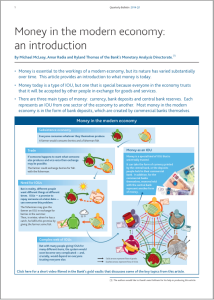
In the words of the Bank of England:
“Economic commentators and academics often pay close attention to the amount of ‘broad money’ circulating in the economy. This can be thought of as the money that consumers have available for transactions, and comprises: currency (banknotes and coin) — an IOU from the central bank, mostly to consumers in the economy; and bank deposits — an IOU from commercial banks to consumers.
“Currency [bank notes and coins] only accounts for a very small amount of the money held by people and firms in the economy. The rest consists of deposits with banks.
“97% of the money held by the public is in the form of deposits with banks, rather than currency.” (Bank of England – Money in the modern economy: an introduction)
So most of the money in our economy is made up of bank deposits – the numbers that you see when you check your balance. And bank deposits are a IOU – a promise to pay, or in accounting terms, a liability – from the bank to you. But it would be wrong to think of these deposits as simply a representation of the cash that the bank owes you; in fact, these deposits function as money:
“In the modern economy, bank deposits are often the default type of money. Most people now receive payment of their salary in bank deposits rather than currency. And rather than swapping those deposits back into currency, many consumers use them as a store of value and, increasingly, as the medium of exchange.
“For example, when a consumer pays a shop by debit card, the banking sector reduces the amount it owes to that consumer — the consumer’s deposits are reduced — while increasing the amount it owes to the shop — the shop’s deposits are increased. The consumer has used the deposits directly as the medium of exchange without having to convert them into currency [notes and coins].” (Bank of England: Money in the modern economy: an introduction)
The Official Report
Money in the modern economy: an introduction
Money creation in the modern economy See our video section for more presentations and animations about how money is created, and the impact this has on society and the economy.
How is Money Created?
“In the modern economy, most money takes the form of bank deposits. But how those bank deposits are created is often misunderstood: the principal way is through commercial banks making loans. Whenever a bank makes a loan, it simultaneously creates a matching deposit in the borrower’s bank account, thereby creating new money.”
“Commercial [i.e. high-street] banks create money, in the form of bank deposits, by making new loans. When a bank makes a loan, for example to someone taking out a mortgage to buy a house, it does not typically do so by giving them thousands of pounds worth of banknotes. Instead, it credits their bank account with a bank deposit of the size of the mortgage. At that moment, new money is created. For this reason, some economists have referred to bank deposits as ‘fountain pen money’, created at the stroke of bankers’ pens when they approve loans.(1)” [our addition in brackets] (Bank of England, Money Creation in the Modern Economy)
In short, money exists as bank deposits – IOUs of commercial banks – and is created through some simple accounting whenever a bank makes a loan.
Learn more about how money is created by banks with our Banking 101 Video Course
Banks aren’t Middlemen between Savers and Borrowers:
There is a common idea – even taught in many economics textbooks and academic papers – that banks are simply middlemen (‘intermediaries’) between savers and borrowers. But this is inaccurate. As the Bank of England describes:
“One common misconception is that banks act simply as intermediaries, lending out the deposits that savers place with them. In this view deposits are typically ‘created’ by the saving decisions of households, and banks then ‘lend out’ those existing deposits to borrowers, for example to companies looking to finance investment or individuals wanting to purchase houses.
“In fact, when households choose to save more money in bank accounts, those deposits come simply at the expense of deposits that would have otherwise gone to companies in payment for goods and services. Saving does not by itself increase the deposits or ‘funds available’ for banks to lend. Indeed, viewing banks simply as intermediaries ignores the fact that, in reality in the modern economy, commercial banks are the creators of deposit money. This article explains how, rather than banks lending out deposits that are placed with them, the act of lending creates deposits — the reverse of the sequence typically described in textbooks.(3)” (Bank of England, Money Creation in the Modern Economy)
Proofs from other central banks:
European Central Bank:
What is money?
Bundesbank:
How money is created
The role of banks, non-banks and the central bank in the money creation process
Bank of Norway:
Speech by Deputy Governor Jon Nicolaisen, 25 April 2017
NEXT: See how much money banks have created
VIDEO: Our Banking 101 video course explains what’s wrong with the usual conception of banking.
Overview
How We Got Here
The laws that make it illegal for you to print your own £5 or £10 notes have been in place since 1844. But these laws have never been updated to account for the fact that 97% of money is now digital.
How Much Money Have Banks Created?
From the time when the Bank of England was formed in 1694, it took over 300 years for banks to create the first trillion pounds. It took them only 8 years to create the second trillion.
The Technical Details
Video Course: Banking 101
This free animated video course (total 57 minutes) explains how the modern banking system creates money, and what limits how much money banks can create.
Books
Advanced: All the technical details
This section covers all the nitty-gritty details of money creation by banks. We cover the three types of money, how balance sheets work, how central and commercial banks create – and destroy – money and what is wrong about the textbooks taught in universities. Read more…
Book: Where Does Money Come From?
“Refreshing and clear. The way monetary economics and banking is taught in many – maybe most – universities is very misleading and this book helps people explain how the mechanics of the system work.”
– Professor David Miles, Monetary Policy Committee, Bank of England
Book: Modernising Money
Why our monetary system is broken, and how to fix it.
“Money is a social invention, indeed among the most important of all social inventions. At present the right to create money has been handed over to the private businesses we call banks. But this is not the only way we could create money and, as recent experience suggests, it may be far from the best one. Read this book with an open mind and you will understand why.”
– Martin Wolf, Chief Economics Commentator, Financial Times
Further Resources
Papers and videos from:
The Bank of England
The International Monetary Fund
Lord Adair Turner, former chairman of the UK’s Financial Services Authority
Other professors and experts in the monetary system